scipy.interpolate.BSpline.
basis_element#
- classmethod BSpline.basis_element(t, extrapolate=True)[Quelle]#
Gibt ein B-Spline-Basiselement
B(x | t[0], ..., t[k+1])zurück.- Parameter:
- tndarray, Form (k+2,)
interne Knoten
- extrapolatebool oder ‘periodic’, optional
ob über das Basisintervall,
t[0] .. t[k+1], hinaus extrapoliert werden soll oder ob NaNs zurückgegeben werden sollen. Wenn ‘periodic’, wird periodische Extrapolation verwendet. Standard ist True.
- Rückgabe:
- basis_elementcallable
Ein aufrufbares Objekt, das ein B-Spline-Basiselement für den Knotenvektor t repräsentiert.
Hinweise
Der Grad des B-Splines, k, wird aus der Länge von t als
len(t)-2abgeleitet. Der Knotenvektor wird konstruiert, indemk+1Elemente an die internen Knoten t angehängt und vorangestellt werden.Beispiele
Konstruieren eines kubischen B-Splines
>>> import numpy as np
>>> from scipy.interpolate import BSpline
>>> b = BSpline.basis_element([0, 1, 2, 3, 4])
>>> k = b.k
>>> b.t[k:-k]
array([ 0.,  1.,  2.,  3.,  4.])
>>> k
3
Konstruieren eines quadratischen B-Splines auf
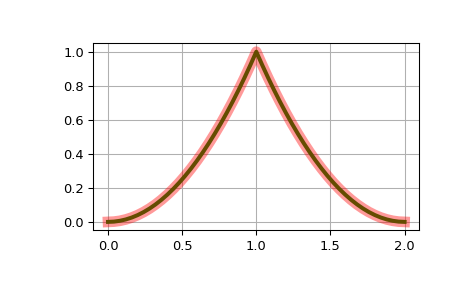
[0, 1, 1, 2]und Vergleichen mit seiner expliziten Form>>> t = [0, 1, 1, 2] >>> b = BSpline.basis_element(t) >>> def f(x): ... return np.where(x < 1, x*x, (2. - x)**2)
>>> import matplotlib.pyplot as plt
>>> fig, ax = plt.subplots()
>>> x = np.linspace(0, 2, 51)
>>> ax.plot(x, b(x), 'g', lw=3)
>>> ax.plot(x, f(x), 'r', lw=8, alpha=0.4)
>>> ax.grid(True)
>>> plt.show()