scipy.special.it2struve0#
- scipy.special.it2struve0(x, out=None) = <ufunc 'it2struve0'>#
Integral im Zusammenhang mit der Struve-Funktion der Ordnung 0.
Gibt das Integral zurück,
\[\int_x^\infty \frac{H_0(t)}{t}\,dt\]wobei \(H_0\) die Struve-Funktion der Ordnung 0 ist.
- Parameter:
- xarray_like
Untere Integrationsgrenze.
- outndarray, optional
Optionales Ausgabe-Array für die Funktionswerte
- Rückgabe:
- ISkalar oder ndarray
Der Wert des Integrals.
Siehe auch
Hinweise
Wrapper für eine Fortran-Routine, erstellt von Shanjie Zhang und Jianming Jin [1].
Referenzen
[1]Zhang, Shanjie und Jin, Jianming. „Computation of Special Functions“, John Wiley and Sons, 1996. https://people.sc.fsu.edu/~jburkardt/f_src/special_functions/special_functions.html
Beispiele
Auswertung der Funktion an einem Punkt.
>>> import numpy as np
>>> from scipy.special import it2struve0
>>> it2struve0(1.)
0.9571973506383524
Auswertung der Funktion an mehreren Punkten durch Angabe eines Arrays für x.
>>> points = np.array([1., 2., 3.5])
>>> it2struve0(points)
array([0.95719735, 0.46909296, 0.10366042])
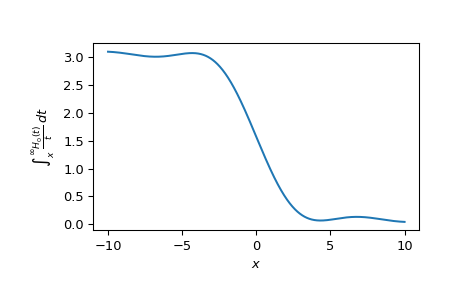
Plotten Sie die Funktion von -10 bis 10.
>>> import matplotlib.pyplot as plt
>>> x = np.linspace(-10., 10., 1000)
>>> it2struve0_values = it2struve0(x)
>>> fig, ax = plt.subplots()
>>> ax.plot(x, it2struve0_values)
>>> ax.set_xlabel(r'$x$')
>>> ax.set_ylabel(r'$\int_x^{\infty}\frac{H_0(t)}{t}\,dt$')
>>> plt.show()