scipy.special.voigt_profile#
- scipy.special.voigt_profile(x, sigma, gamma, out=None) = <ufunc 'voigt_profile'>#
Voigt-Profil.
Das Voigt-Profil ist eine Faltung einer 1D-Normalverteilung mit Standardabweichung
sigmaund einer 1D-Cauchy-Verteilung mit halber Breite bei halber maximaler Höhegamma.Wenn
sigma = 0, wird die Wahrscheinlichkeitsdichtefunktion (PDF) der Cauchy-Verteilung zurückgegeben. Umgekehrt, wenngamma = 0, wird die PDF der Normalverteilung zurückgegeben. Wennsigma = gamma = 0, ist der RückgabewertInffürx = 0und0für alle anderenx.- Parameter:
- xarray_like
Reeller Argument
- sigmaarray_like
Die Standardabweichung des Normalverteilungsanteils
- gammaarray_like
Die halbe Breite bei halber maximaler Höhe des Cauchy-Verteilungsanteils
- outndarray, optional
Optionales Ausgabe-Array für die Funktionswerte
- Rückgabe:
- skalar oder ndarray
Das Voigt-Profil an den gegebenen Argumenten
Siehe auch
wofzFaddeeva-Funktion
Hinweise
Es kann durch die Faddeeva-Funktion ausgedrückt werden
\[V(x; \sigma, \gamma) = \frac{Re[w(z)]}{\sigma\sqrt{2\pi}},\]\[z = \frac{x + i\gamma}{\sqrt{2}\sigma}\]wobei \(w(z)\) die Faddeeva-Funktion ist.
Referenzen
Beispiele
Berechnen Sie die Funktion am Punkt 2 für
sigma=1undgamma=1.>>> from scipy.special import voigt_profile >>> import numpy as np >>> import matplotlib.pyplot as plt >>> voigt_profile(2, 1., 1.) 0.09071519942627544
Berechnen Sie die Funktion an mehreren Punkten, indem Sie ein NumPy-Array für x angeben.
>>> values = np.array([-2., 0., 5])
>>> voigt_profile(values, 1., 1.)
array([0.0907152 , 0.20870928, 0.01388492])
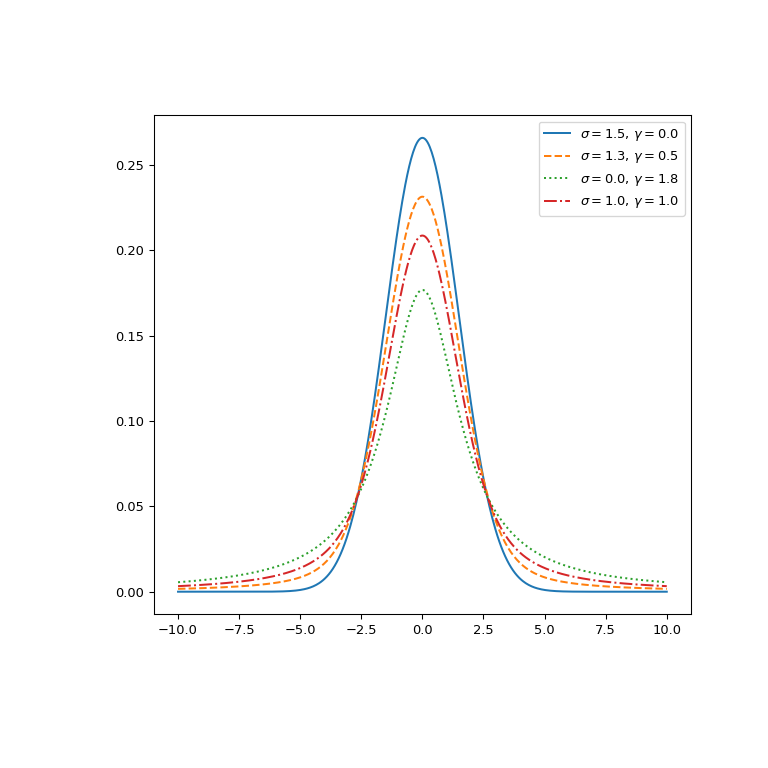
Zeichnen Sie die Funktion für verschiedene Parametersätze.
>>> fig, ax = plt.subplots(figsize=(8, 8))
>>> x = np.linspace(-10, 10, 500)
>>> parameters_list = [(1.5, 0., "solid"), (1.3, 0.5, "dashed"),
...                    (0., 1.8, "dotted"), (1., 1., "dashdot")]
>>> for params in parameters_list:
...     sigma, gamma, linestyle = params
...     voigt = voigt_profile(x, sigma, gamma)
...     ax.plot(x, voigt, label=rf"$\sigma={sigma},\, \gamma={gamma}$",
...             ls=linestyle)
>>> ax.legend()
>>> plt.show()
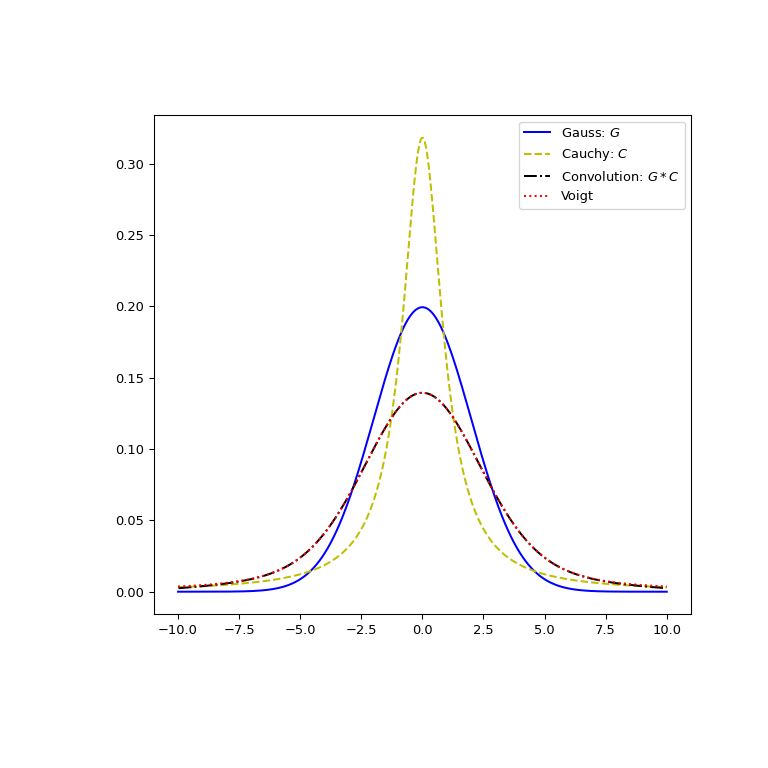
Überprüfen Sie visuell, dass das Voigt-Profil tatsächlich als Faltung einer Normal- und einer Cauchy-Verteilung entsteht.
>>> from scipy.signal import convolve
>>> x, dx = np.linspace(-10, 10, 500, retstep=True)
>>> def gaussian(x, sigma):
...     return np.exp(-0.5 * x**2/sigma**2)/(sigma * np.sqrt(2*np.pi))
>>> def cauchy(x, gamma):
...     return gamma/(np.pi * (np.square(x)+gamma**2))
>>> sigma = 2
>>> gamma = 1
>>> gauss_profile = gaussian(x, sigma)
>>> cauchy_profile = cauchy(x, gamma)
>>> convolved = dx * convolve(cauchy_profile, gauss_profile, mode="same")
>>> voigt = voigt_profile(x, sigma, gamma)
>>> fig, ax = plt.subplots(figsize=(8, 8))
>>> ax.plot(x, gauss_profile, label="Gauss: $G$", c='b')
>>> ax.plot(x, cauchy_profile, label="Cauchy: $C$", c='y', ls="dashed")
>>> xx = 0.5*(x[1:] + x[:-1])  # midpoints
>>> ax.plot(xx, convolved[1:], label="Convolution: $G * C$", ls='dashdot',
...         c='k')
>>> ax.plot(x, voigt, label="Voigt", ls='dotted', c='r')
>>> ax.legend()
>>> plt.show()