
scipy.special.
diric#
- scipy.special.diric(x, n)[Quelle]#
Periodische Sinc-Funktion, auch Dirichlet-Funktion genannt.
Die Dirichlet-Funktion ist definiert als
diric(x, n) = sin(x * n/2) / (n * sin(x / 2)),
wobei n eine positive ganze Zahl ist.
- Parameter:
- xarray_like
Eingabedaten
- nint
Ganze Zahl, die die Periodizität definiert.
- Rückgabe:
- diricndarray
Beispiele
>>> import numpy as np
>>> from scipy import special
>>> import matplotlib.pyplot as plt
>>> x = np.linspace(-8*np.pi, 8*np.pi, num=201)
>>> plt.figure(figsize=(8, 8));
>>> for idx, n in enumerate([2, 3, 4, 9]):
...     plt.subplot(2, 2, idx+1)
...     plt.plot(x, special.diric(x, n))
...     plt.title('diric, n={}'.format(n))
>>> plt.show()
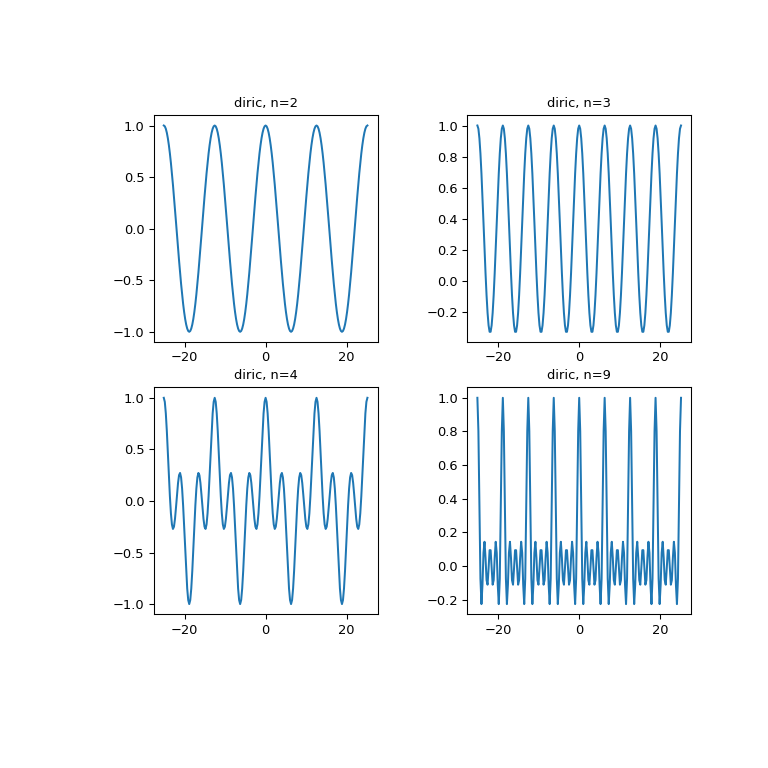
Das folgende Beispiel zeigt, dass
diricdie Amplituden (modulo Vorzeichen und Skalierung) der Fourier-Koeffizienten eines Rechteckimpulses liefert.Unterdrücke die Ausgabe von Werten, die effektiv 0 sind
>>> np.set_printoptions(suppress=True)
Erstelle ein Signal x der Länge m mit k Einsen
>>> m = 8
>>> k = 3
>>> x = np.zeros(m)
>>> x[:k] = 1
Verwende die FFT, um die Fourier-Transformation von x zu berechnen, und inspiziere die Amplituden der Koeffizienten
>>> np.abs(np.fft.fft(x))
array([ 3.        ,  2.41421356,  1.        ,  0.41421356,  1.        ,
        0.41421356,  1.        ,  2.41421356])
Finde nun dieselben Werte (bis auf das Vorzeichen) mit
diric. Wir multiplizieren mit k, um die unterschiedlichen Skalierungskonventionen vonnumpy.fft.fftunddiriczu berücksichtigen.>>> theta = np.linspace(0, 2*np.pi, m, endpoint=False) >>> k * special.diric(theta, k) array([ 3. , 2.41421356, 1. , -0.41421356, -1. , -0.41421356, 1. , 2.41421356])