scipy.special.shichi#
- scipy.special.shichi(x, out=None) = <ufunc 'shichi'>#
Hyperbolische Sinus- und Cosinus-Integrale.
Das hyperbolische Sinusintegral ist
\[\int_0^x \frac{\sinh{t}}{t}dt\]und das hyperbolische Cosinusintegral ist
\[\gamma + \log(x) + \int_0^x \frac{\cosh{t} - 1}{t} dt\]wobei \(\gamma\) die Euler-Mascheroni-Konstante ist und \(\log\) der Hauptzweig des Logarithmus ist [1].
- Parameter:
- xarray_like
Reelle oder komplexe Punkte, an denen die hyperbolischen Sinus- und Cosinusintegrale berechnet werden sollen.
- outtuple von ndarray, optional
Optionale Ausgabe-Arrays für die Funktionsergebnisse
- Rückgabe:
- siSkalar oder ndarray
Hyperbolisches Sinusintegral bei
x- ciSkalar oder ndarray
Hyperbolisches Cosinusintegral bei
x
Siehe auch
Hinweise
Für reelle Argumente mit
x < 0istchider Realteil des hyperbolischen Cosinusintegrals. Für solche Punkte unterscheiden sichchi(x)undchi(x + 0j)um den Faktor1j*pi.Für reelle Argumente wird die Funktion durch Aufruf der Cephes-Routine [2] shichi berechnet. Für komplexe Argumente basiert der Algorithmus auf den Mpmath-Routinen [3] shi und chi.
Referenzen
[1]Milton Abramowitz und Irene A. Stegun, Hrsg. Handbook of Mathematical Functions with Formulas, Graphs, and Mathematical Tables. New York: Dover, 1972. (Siehe Abschnitt 5.2.)
[2]Cephes Mathematical Functions Library, http://www.netlib.org/cephes/
[3]Fredrik Johansson und andere. „mpmath: a Python library for arbitrary-precision floating-point arithmetic“ (Version 0.19) http://mpmath.org/
Beispiele
>>> import numpy as np
>>> import matplotlib.pyplot as plt
>>> from scipy.special import shichi, sici
shichiakzeptiert reelle oder komplexe Eingaben>>> shichi(0.5) (0.5069967498196671, -0.05277684495649357) >>> shichi(0.5 + 2.5j) ((0.11772029666668238+1.831091777729851j), (0.29912435887648825+1.7395351121166562j))
Die hyperbolischen Sinus- und Cosinusintegrale Shi(z) und Chi(z) sind mit den Sinus- und Cosinusintegralen Si(z) und Ci(z) wie folgt verwandt:
Shi(z) = -i*Si(i*z)
Chi(z) = Ci(-i*z) + i*pi/2
>>> z = 0.25 + 5j
>>> shi, chi = shichi(z)
>>> shi, -1j*sici(1j*z)[0]            # Should be the same.
((-0.04834719325101729+1.5469354086921228j),
 (-0.04834719325101729+1.5469354086921228j))
>>> chi, sici(-1j*z)[1] + 1j*np.pi/2  # Should be the same.
((-0.19568708973868087+1.556276312103824j),
 (-0.19568708973868087+1.556276312103824j))
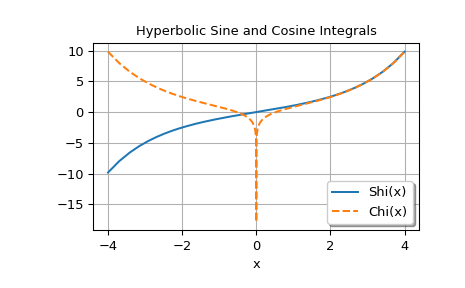
Funktionen, die auf der reellen Achse ausgewertet werden, plotten
>>> xp = np.geomspace(1e-8, 4.0, 250)
>>> x = np.concatenate((-xp[::-1], xp))
>>> shi, chi = shichi(x)
>>> fig, ax = plt.subplots()
>>> ax.plot(x, shi, label='Shi(x)')
>>> ax.plot(x, chi, '--', label='Chi(x)')
>>> ax.set_xlabel('x')
>>> ax.set_title('Hyperbolic Sine and Cosine Integrals')
>>> ax.legend(shadow=True, framealpha=1, loc='lower right')
>>> ax.grid(True)
>>> plt.show()