scipy.special.itj0y0#
- scipy.special.itj0y0(x, out=None) = <ufunc 'itj0y0'>#
Integrale von Bessel-Funktionen der ersten Art der Ordnung 0.
Berechnet die Integrale
\[\begin{split}\int_0^x J_0(t) dt \\ \int_0^x Y_0(t) dt.\end{split}\]Weitere Informationen zu \(J_0\) und \(Y_0\) finden Sie unter
j0undy0.- Parameter:
- xarray_like
Werte, an denen die Integrale ausgewertet werden sollen.
- outTupel von ndarrays, optional
Optionale Ausgabearrays für die Funktionsergebnisse.
- Rückgabe:
Referenzen
[1]S. Zhang und J.M. Jin, „Computation of Special Functions“, Wiley 1996
Beispiele
Werten Sie die Funktionen an einem Punkt aus.
>>> from scipy.special import itj0y0
>>> int_j, int_y = itj0y0(1.)
>>> int_j, int_y
(0.9197304100897596, -0.637069376607422)
Werten Sie die Funktionen an mehreren Punkten aus.
>>> import numpy as np
>>> points = np.array([0., 1.5, 3.])
>>> int_j, int_y = itj0y0(points)
>>> int_j, int_y
(array([0.        , 1.24144951, 1.38756725]),
 array([ 0.        , -0.51175903,  0.19765826]))
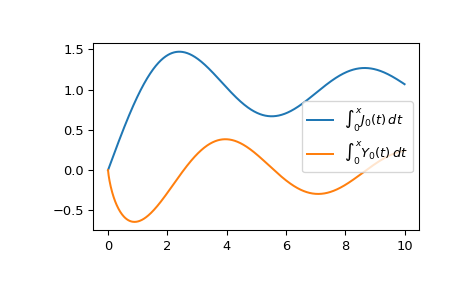
Plotten Sie die Funktionen von 0 bis 10.
>>> import matplotlib.pyplot as plt
>>> fig, ax = plt.subplots()
>>> x = np.linspace(0., 10., 1000)
>>> int_j, int_y = itj0y0(x)
>>> ax.plot(x, int_j, label=r"$\int_0^x J_0(t)\,dt$")
>>> ax.plot(x, int_y, label=r"$\int_0^x Y_0(t)\,dt$")
>>> ax.legend()
>>> plt.show()